Spatial intelligence and immersive systems as frameworks for mediating reality, cognition, and public space
Developing theoretical and applied models for spatial cognition and human–AI mediation, translating research into scalable architectural intelligence.
The Spatial Intelligence Loop
Spatial intelligence emerges through a continuous loop of sensing, inference, reasoning, and perceptual feedback.
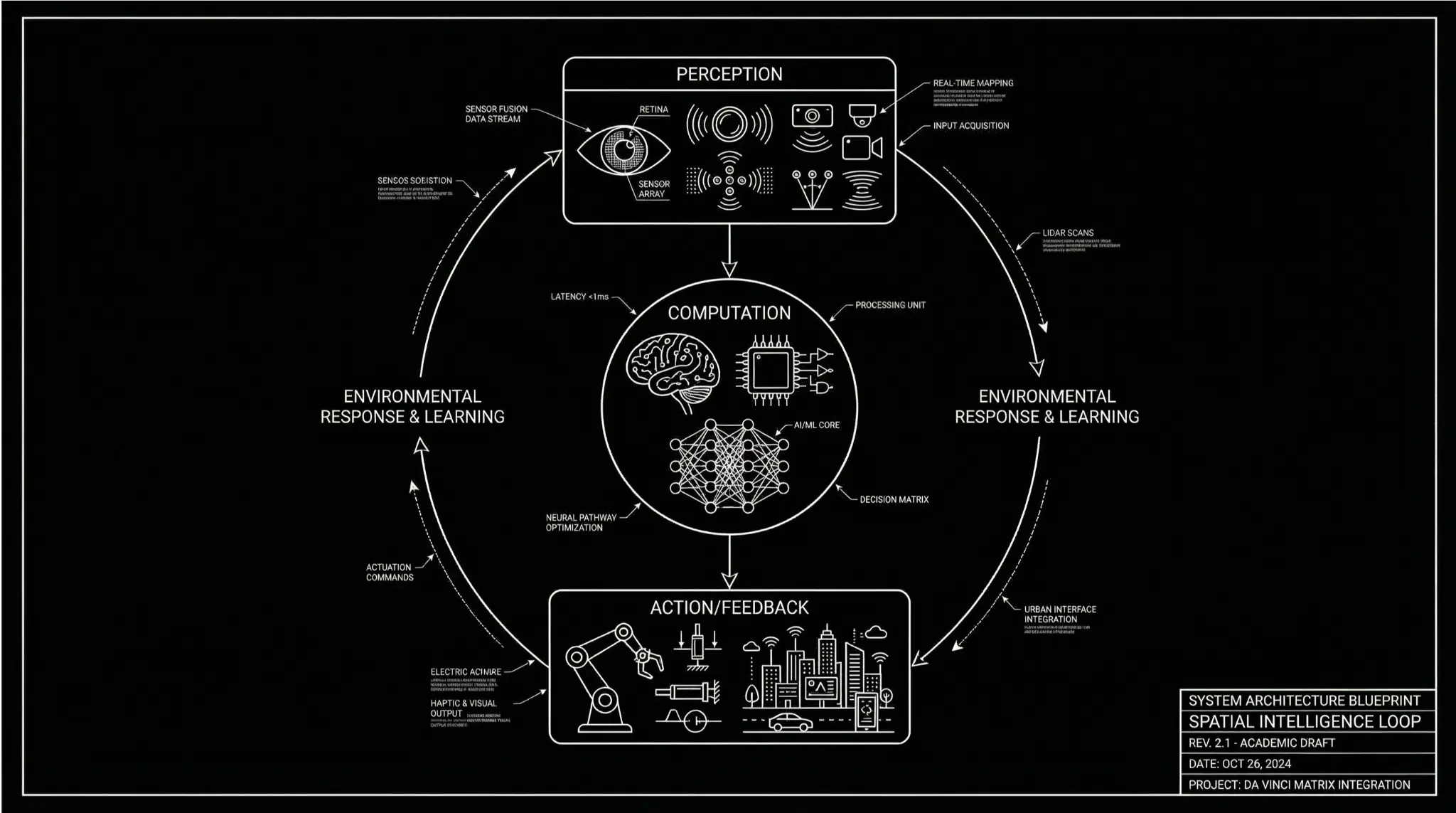
1. Spatial Signals
Raw observations from space: human presence, movement, density, and environmental inputs.
2. Spatial State Inference
From data to spatial meaning: interpretable spatial states derived via rule-based or heuristic logic.
3. Spatial Reasoning
System-level judgement and response: decision logic, spatial balance, and intervention strategies.
4. Perceptual Interface
Making system state perceivable: XR overlays and minimal HUD feedback to mediate intelligence.
Spatial Cognition Frameworks
Systematic analysis of AR interface impact on spatial memory and urban navigation. Developing protocols for cognitive-load-aware spatial computing.
ESG Compliance Systems
Automated environmental sensing platforms. Integrating low-carbon robotics with real-time pipeline inspection HUDs for regulatory compliance and site monitoring.

Data Privacy Architecture
Ethical frameworks for spatial data collection. Designing privacy-preserving protocols for always-on wearable sensing systems.
“A critical advancement in the integration of AI systems with the built environment.”— Shanghai Jiao Tong University